Designing an Incoming Acceptance Test for a Linear Stage
A new linear stage arrives, powers up and moves smoothly from end to end. That proves very little. Smooth travel is not an accuracy result, a tight cluster of return readings does not show a small positioning error, and a correction file does not prove the corrected system meets its requirement. The positioningstages.com guide on designing an incoming acceptance test for a linear stage, together with related articles on reversal error and error maps, explains how to build a test that answers the questions you actually bought the stage to solve.
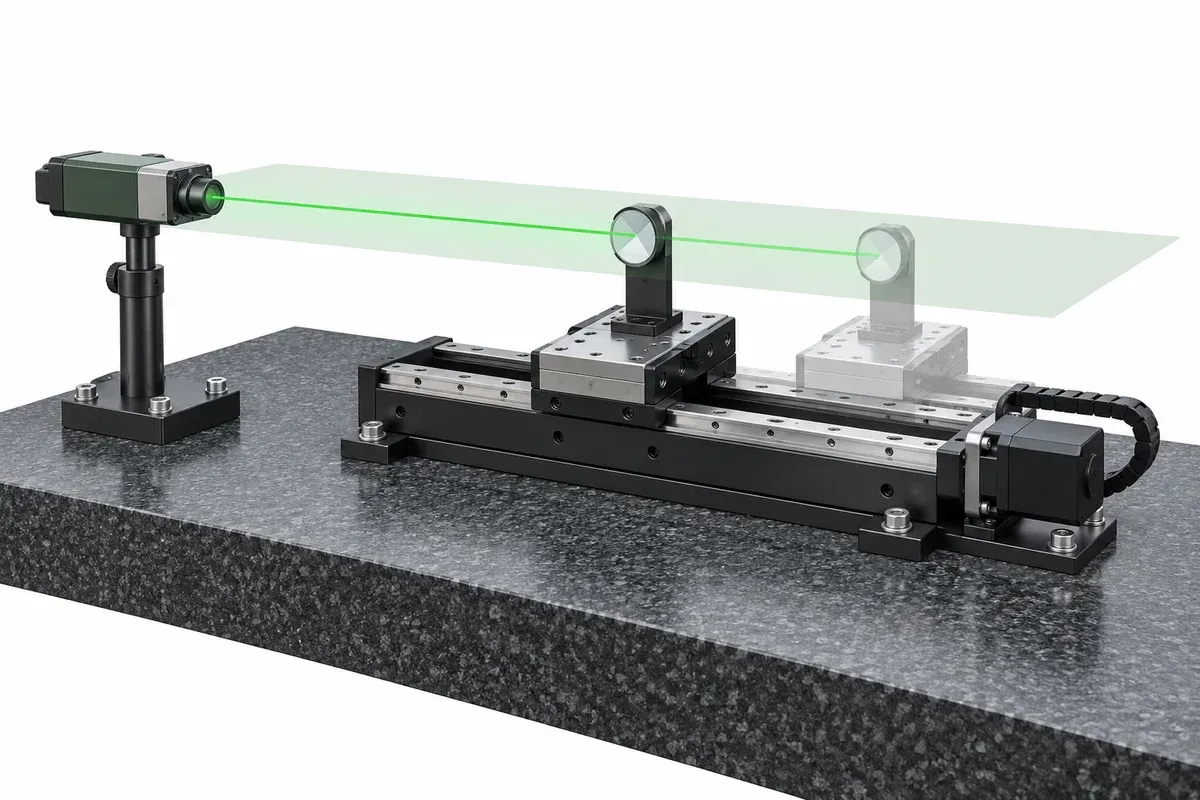
AI-generated illustration of an independently mounted reference instrument aimed at a target on a linear stage carriage. Image: positioningstages.com.
Agree what acceptance will establish, before delivery
An incoming test can establish whether an identified stage and controller configuration meets an agreed requirement under recorded conditions. Start from the purchase requirement, then choose the measurement and decision rule. A shipping inspection does not establish positioning accuracy, repeated-return behaviour or the smallest useful motion; each needs its own evidence.
Agree the working range, payload point, responsibilities and unresolved requirements before the stage ships. The site's catalogue basis page helps separate documented values, derived values and unconfirmed claims. The guide's worksheets are planning aids to adapt with the responsible engineer, not a certified procedure.
Build an acceptance matrix
Give each characteristic its own requirement ID, agreed limit and decision rule. Anything not tested stays marked "not evaluated", even if neighbouring checks pass. The guide's matrix includes:
- Received condition and configuration: compare model, serial numbers, accessories, firmware and compensation files with the order before changing any settings.
- Safe functional travel: define the permitted envelope, limit behaviour and operating settings; successful travel is not an accuracy result.
- Positioning error: agree targets, arrival direction, load, measurement line, settling method and an independent physical reference over the required region.
- Repeated-return behaviour: return to the same targets under a declared approach policy, separating same-direction arrivals from reversals with homing held fixed.
- Homing or restart behaviour: define the restart sequence and which reference and configuration are retained.
The matrix supplies no universal limits or repetition counts; those belong to your requirement. For the underlying definitions, see accuracy, repeatability and resolution as three separate acceptance questions.
Measure at the payload point
Use documented reference instrumentation, mounted independently of the moving carriage, aimed at the point that matters for the process. Keep raw observations, setup details and any unresolved deviations. If the reference must be reset, record how its relationship to the stage was restored.
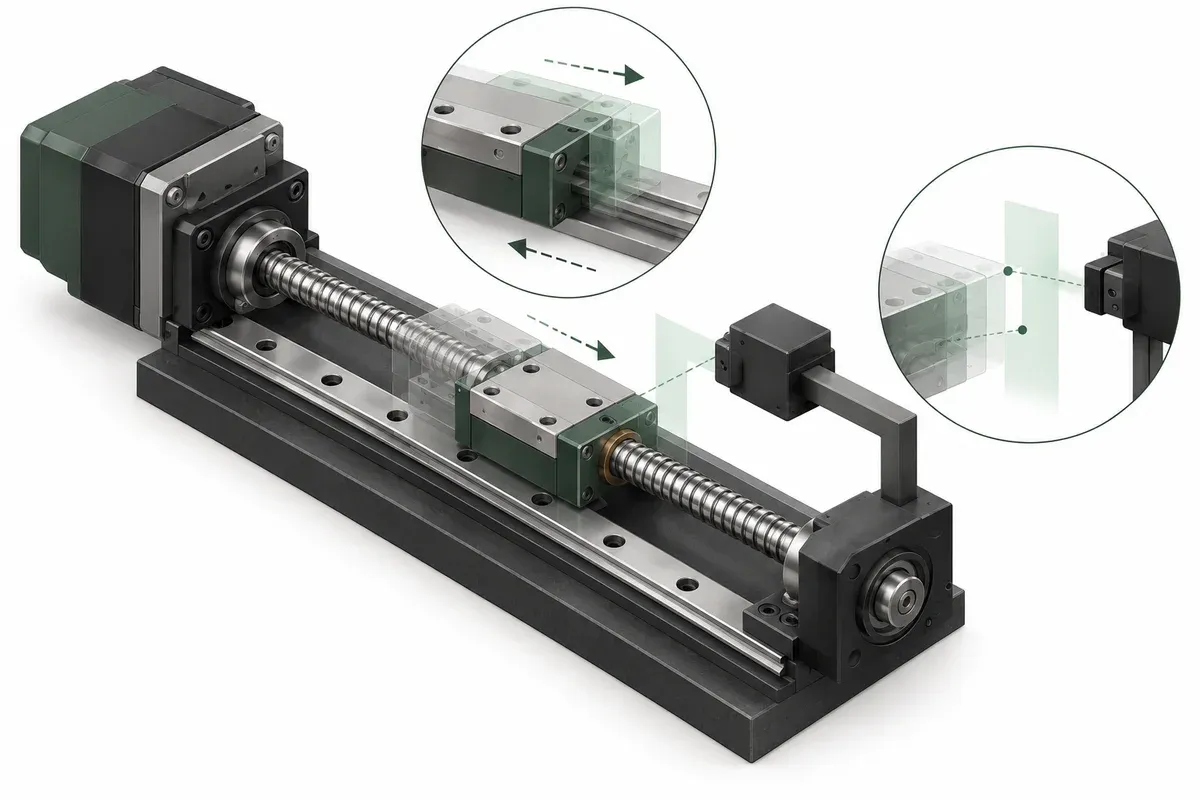
AI-generated concept illustration of measuring reversal error from two approach directions on a linear stage. Image: positioningstages.com.
Measure reversal error before calling it backlash
When opposite approaches reach different positions, it is tempting to write "backlash" on the report. The guide on measuring reversal error without calling every error backlash recommends recording the direction-dependent observation first and the proposed mechanism separately.
Establish a direction-controlled baseline at a safe target with room to approach from both sides. Fix excursion, final approach speed, acceleration, dwell and measurement interval, and record the actual sequence, because a nominally negative command may still end with a positive final approach. Measure repeated arrivals from each side without re-zeroing between groups, keep timestamps so thermal drift can be considered, and plot the two groups separately. Then investigate one influence at a time, such as dwell, excursion or cable support, before touching mechanical preload or controller compensation.
Treat error maps as hypotheses until validated
The guide on what an error map can correct and what it cannot prove keeps map generation, implementation and validation separate. A map addresses modelled, repeatable behaviour under its stated conditions. Record the stage, controller, reference method, payload, orientation, travel interval and approach directions used to build it, and do not describe a one-axis correction as volumetric compensation.
Validate with positions not used to fit the map, keep uncorrected and corrected datasets separate, check sign and coordinate conventions, and avoid correcting the same contribution twice. A local validation should not be generalised to the whole travel or another payload height.
Preserve the evidence
The final record should hold the configuration snapshot, raw readings, coordinate transformations, environmental notes and every unresolved deviation. It should be possible for someone who was not present to understand what was measured, where, with which reference and under which configuration, and to repeat the test later. That matters when a question arises months after installation, or when the stage is moved to a different fixture and must be re-qualified. A good acceptance record also makes it clear which characteristics were never evaluated, so that nobody later assumes a check was done simply because it appears in the matrix. Store it with the purchase order, quotation and drawings for future reference. Candidate stages can be reviewed on the motorized linear stages page, and acceptance requirements can be sent with an enquiry through request a quote or to sales@positioningstages.com.
FAQ
What should an incoming stage acceptance test establish?
Whether an identified stage and controller configuration meet agreed requirements under recorded conditions, using agreed decision rules.
Is a narrow spread of return readings proof of accuracy?
No. A narrow spread shows repeatability; positioning error must be measured against an independent reference.
Should direction-dependent error be called backlash?
Not immediately. Record it as reversal error and investigate possible causes one at a time.
How should an error map be validated?
At positions not used to fit the map, with corrected and uncorrected data kept separate.
Contact positioningstages.com: email sales@positioningstages.com · positioningstages.com